
How Does Air Cargo Dead Body Transport Work from Kolkata Airport?

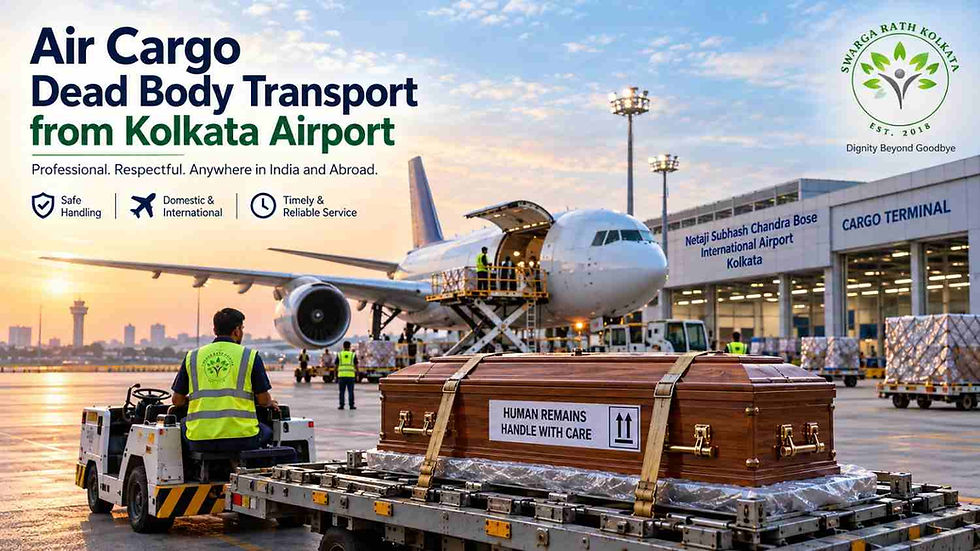
When a loved one needs to be transported from Kolkata to another city or country after death, families often have one urgent question: how does air cargo dead body transport actually work?
Transporting human remains by air is different from booking an ordinary passenger flight. The process can involve body preparation, embalming where required, an appropriate coffin or transport container, death-related documents, police or other clearances where applicable, airline cargo booking, airport cargo acceptance, and arrangements for receiving the deceased at the destination.
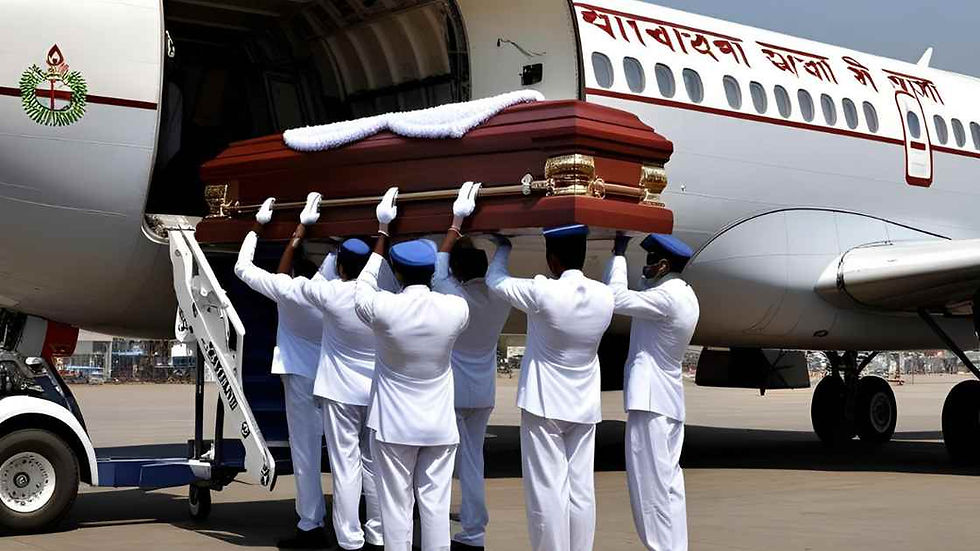
For families in Kolkata, the process generally begins before reaching Netaji Subhas Chandra Bose International Airport (NSCBI Airport). The body must first be prepared and the required documents verified. The prepared coffin is then taken to the designated cargo facility, accepted by the airline or cargo handler, and transported to the destination airport.
For families who need professional assistance with dead body transport by air cargo from Kolkata, the process can be coordinated from body preparation and documentation through airport cargo handover and destination arrangements.
This guide explains the complete air cargo dead body transport workflow from Kolkata, from the initial documentation to final handover at the destination.
Important: Requirements are not identical for every case. Airline rules, destination requirements, whether the transfer is domestic or international, the cause and circumstances of death, and applicable public-health regulations can change the documents and clearances required.
When Should a Family Choose Air Cargo?
Air cargo is generally considered when the destination is far enough away that road transportation may be impractical or when the family needs a faster long-distance transportation option.
It may be considered for:
Situation | Why air cargo may be considered |
Kolkata to another Indian state | Reduces the travel time associated with very long road journeys |
Kolkata to a distant city | Useful when timely arrival is important |
International repatriation | Air transportation is generally required for overseas movement. |
Funeral arrangements at a distant hometown | Can help coordinate transportation with a planned funeral |
Time-sensitive family circumstances | May provide a faster long-distance option when an airline accepts the shipment |
Air cargo is not automatically the right choice in every case. The final option depends on the destination, available flights, airline acceptance, documentation, and the family's circumstances.
For shorter or practical interstate journeys, road transportation may sometimes be simpler because it provides direct door-to-door movement.
The Complete Air Cargo Dead Body Transport Process from Kolkata
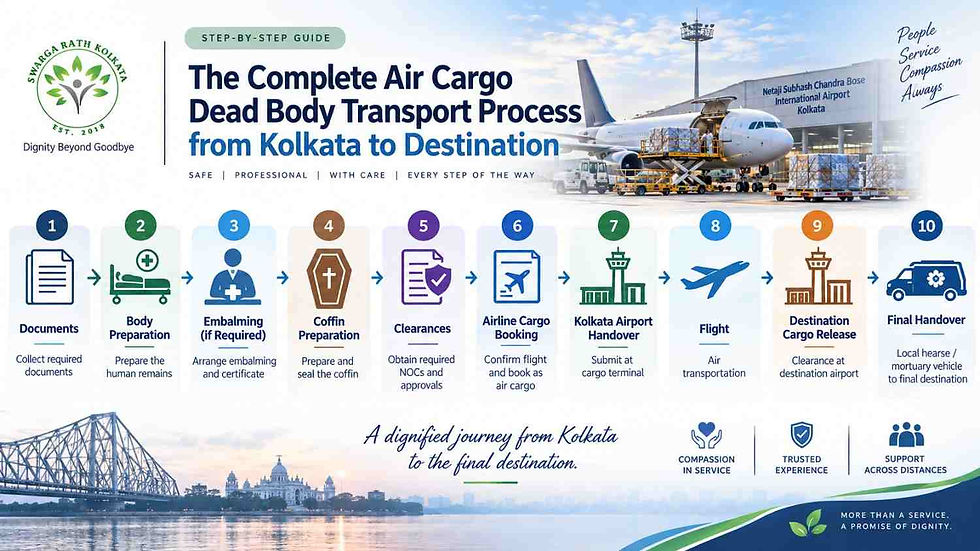
A typical process can be understood as
Death-related documents → Body preparation → Embalming if required → Coffin preparation → Required certificates/NOCs → Airline cargo booking → Kolkata Airport cargo handover → Airline acceptance → Flight → Destination cargo release → Final transportation
Each stage is important because a problem at one stage can affect the next.
Step 1—Obtain the Death-Related Documents
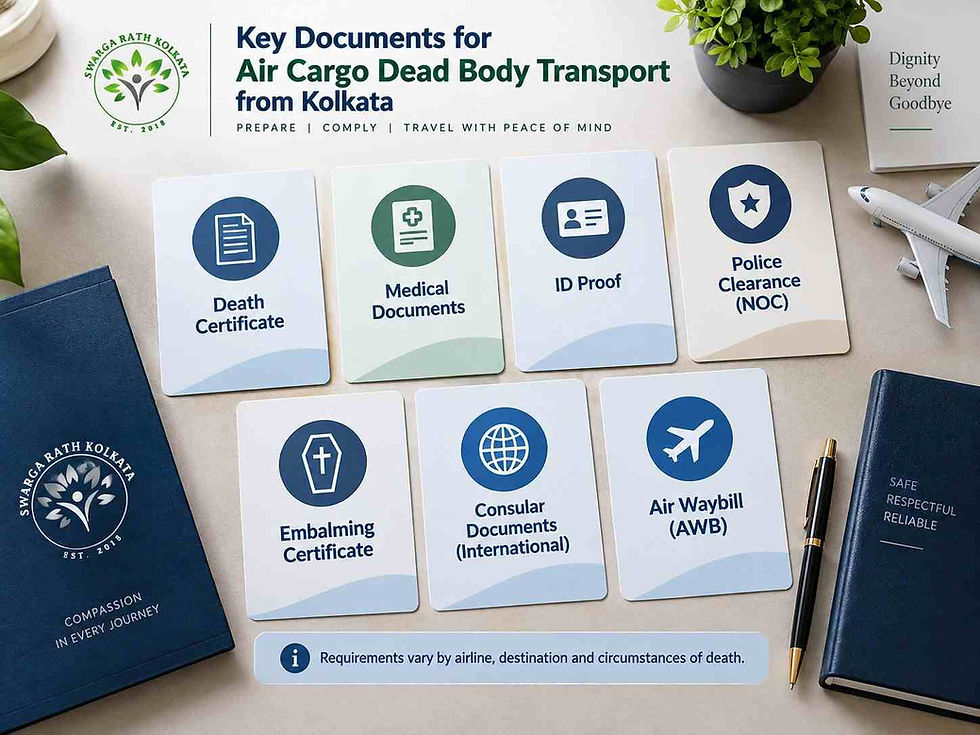
The first step is to collect the documents issued after the death.
The exact paperwork depends on where and how the death occurred.
Common documents can include:
Death certificate or appropriate medical death documentation
Hospital death summary/release documents, where applicable
Government-issued identity proof of the deceased
Medical or cause-of-death documentation
Police documents or NOC where required
Postmortem/inquest documents in applicable cases
Identification of the receiving family member or authorized representative
For international cases involving human remains being brought into India, families or authorized representatives can also refer to the Government of India's eCARe portal for human remains clearance.
For a hospital death, the hospital generally provides the relevant medical documentation and releases the deceased according to its procedures.
Before arranging air cargo, families should understand the broader government rules for dead body transport in India, including the documentation and clearance requirements that can apply to different transportation situations.
For an accidental, unnatural, or otherwise legally sensitive death, additional police or medico-legal documentation may be required before transportation can proceed.
Why should documents be checked before booking the flight?
Because an airline cargo booking does not by itself guarantee acceptance of human remains.
The airline may need to verify the required documents and acceptance conditions before the shipment is accepted.
Practical tip: Do not wait until the coffin reaches the airport to discover that an important certificate or clearance is missing.
Step 2 — Determine Whether Embalming Is Required
One of the most important questions families ask is
Is embalming mandatory for dead body transport by air?
There is no single answer that applies to every domestic and international movement.
Embalming requirements can depend on:
Airline requirements
Destination requirements
Domestic or international transportation
Public health requirements
Cause and circumstances of death
Transit-country requirements
Duration and nature of the journey
For many air-cargo arrangements involving a body in a coffin, an embalming certificate may be required by the airline or destination authorities.
For international movements, requirements can be more extensive because the destination country may impose additional public health, consular, or immigration requirements.
Therefore, the correct approach is to confirm the applicable requirements before the body is prepared for shipment.
Domestic vs. International Air Cargo
Requirement | Domestic movement within India | International movement |
Death documentation | Required | Required |
Embalming | Depends on applicable airline/route requirements | Frequently required and may be required by destination |
Embalming certificate | Where embalming is required | Commonly required |
Police clearance/NOC | Depending on circumstances and airline requirements | May be required |
Coffin/packaging documentation | Depending on airline requirements | Additional requirements may apply. |
Passport | Generally not required for domestic transport | May require cancellation/other passport documentation |
Embassy/consular documentation | Normally not applicable | May be required |
Customs/public-health clearance | Normally not applicable in the same way as international repatriation | May be required |
Destination-country permission | Not applicable | May be required |
The table is a practical overview rather than a universal checklist. Always confirm the final requirements for the specific airline, route, and destination.
Step 3—Arrange Embalming Service and the Embalming
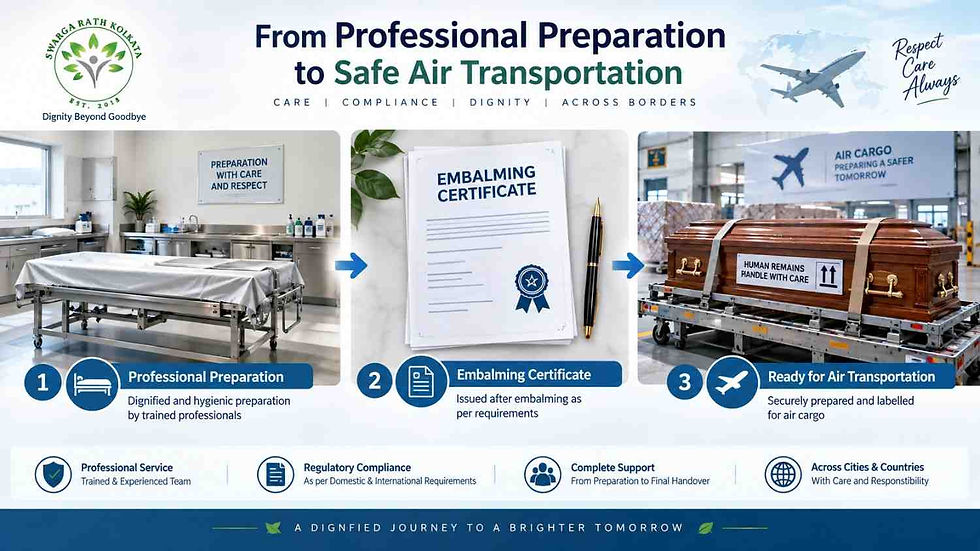
When embalming is required, the body is prepared by an authorized medical/embalming facility according to applicable procedures.
The family should obtain the relevant embalming certificate after the procedure.
The certificate may be required to confirm that:
The deceased has been embalmed
The identity of the deceased is correctly recorded
The applicable embalming procedure has been completed
The body has been prepared for transportation
The packaging/sealing information required by the relevant authority is documented
For international repatriation, document wording and supporting information can be particularly important.
If a document is not in English, an accurate English translation may be required depending on the airline and destination requirements.
Families who are also considering temporary preservation before transportation can read our guide on embalming vs. freezer box to understand how the two methods differ.
Why is the embalming certificate important?
The embalming certificate is not simply a medical record. For air transportation, it can form part of the documentation package used by the airline, airport authorities, or public health authorities.
Families should therefore keep the original certificate safely available and provide copies only where the receiving authority or airline permits.
Step 4—Prepare the Coffin or Air-Transport Container
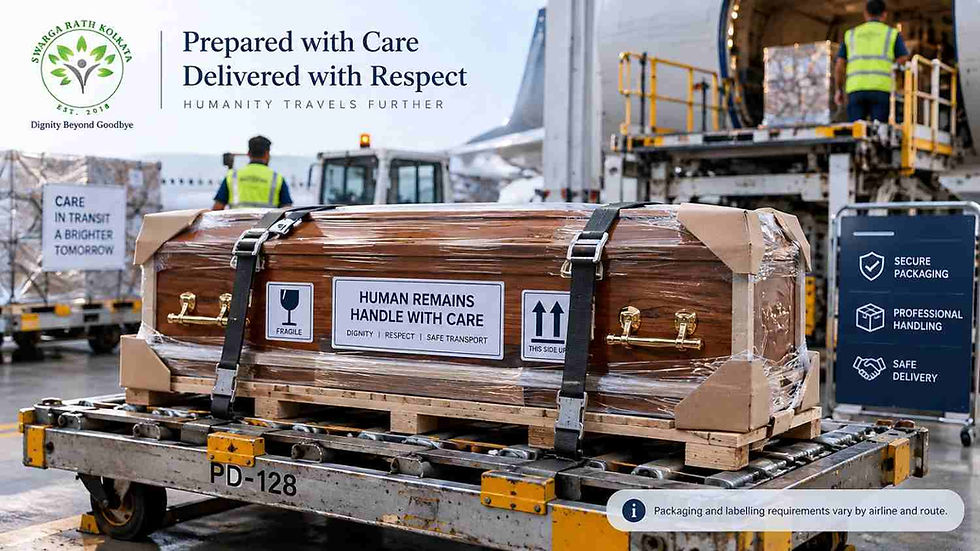
The next stage is preparing the deceased for air transportation.
The coffin or transport container must meet the applicable airline, public health, and packaging requirements.
Depending on the route and requirements, the preparation can involve:
Appropriate coffin construction
Internal protective lining
Leak-resistant preparation
Secure sealing
External packaging
Correct identification and labeling
Handling instructions
Supporting certification
A commonly requested document is a coffin/sealing certificate or certificate of packaging, but the exact terminology and requirements vary.
For broader industry guidance, the IATA Compassionate Transportation Manual covers airline acceptance and the preparation, packaging, documentation, handling, and transportation of human remains.
What is a coffin certificate?
A coffin certificate generally provides documentary confirmation concerning the preparation, sealing, or packaging of the coffin for transportation.
The exact certificate name and issuing authority can vary according to the route, airline, and applicable requirements.
Why does coffin sealing matter?
Human remains transported by air must be packaged appropriately to prevent leakage and damage during handling and transportation.
Airline guidance also requires suitable marking and labeling for human-remains shipments.
The coffin should therefore be prepared according to the specific airline's current acceptance requirements, rather than relying only on a generic coffin specification.
Step 5—Obtain Police NOC and Other Clearances
Not every case requires exactly the same police documentation.
A police NOC, clearance, or other legal documentation may be required depending on:
Whether the death was natural or unnatural
Whether the case is medico-legal
Whether a postmortem was conducted
Airline requirements
Destination requirements
International repatriation requirements
In an accidental, suspicious, or unnatural death, additional documentation may be required before the deceased can be released for transportation.
For international cases, additional documents may include:
Passport-related documentation
Consular certificate/NOC
Embassy documentation
Public-health clearance
Customs documentation
Destination-country permissions
Do not assume that a document required for an international case is automatically required for a domestic Kolkata-to-Delhi or Kolkata-to-Chennai transfer, or vice versa.
Step 6 — Book Human Remains as Air Cargo
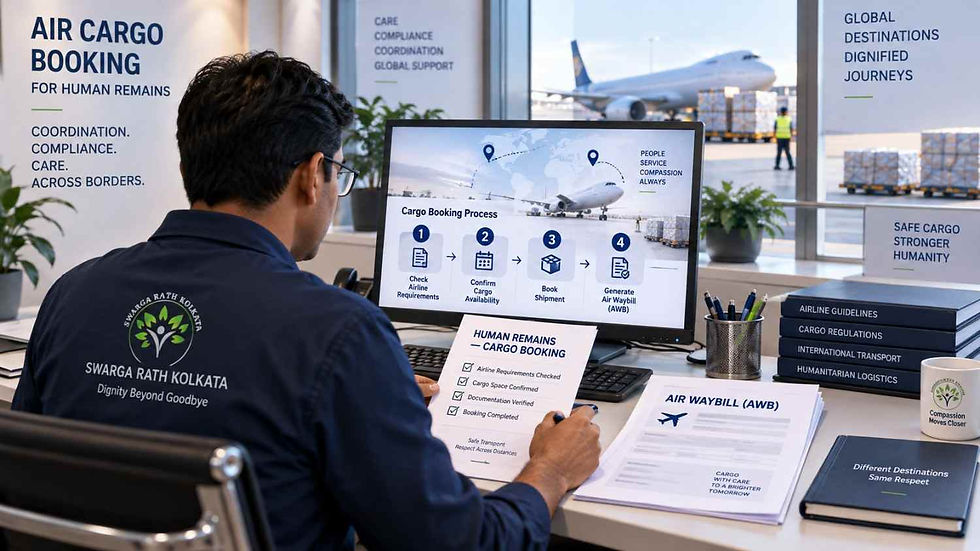
Once the body preparation and documentation are ready, the next stage is airline cargo booking.
Human remains are handled as a special cargo category, not as ordinary passenger baggage.
The booking normally requires information such as
Name of deceased
Origin airport
Destination airport
Consignee details
Shipper details
Approximate package/coffin dimensions
Weight
Required documents
Flight/route information
Special handling requirements
The airline or cargo agent confirms whether the route and flight can accept the human-remains shipment. Because airline acceptance requirements can differ, families should confirm the current requirements directly with the operating airline or its cargo division before taking the shipment to the airport.
For example, Air India's human-remains cargo requirements specify advance arrangements and documents such as the death certificate, embalming certificate for bodies in coffins, police clearance, and packaging certification.
Why should the airline be contacted before going to the airport?
Because cargo acceptance is subject to airline and route availability.
A family should ideally have:
Confirmed cargo booking + documentation verification + confirmed airport handover instructions
before taking the coffin to the cargo terminal.
Step 7—Kolkata Airport Cargo Handling
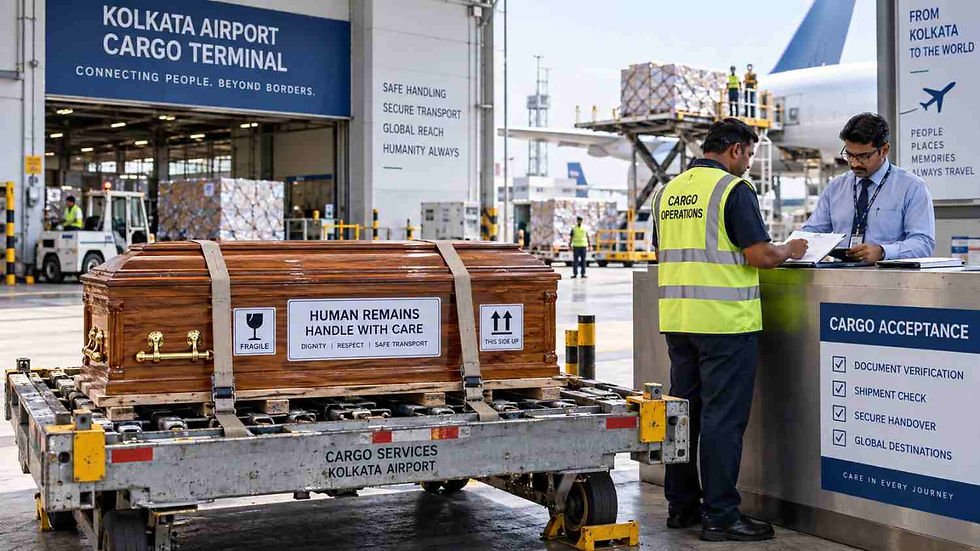
For air cargo dead body transport from Kolkata, the relevant airport is Netaji Subhas Chandra Bose International Airport (CCU/NSCBI Airport).
Kolkata Airport has an integrated air-cargo infrastructure serving domestic and international freight operations.
The human remains do not normally follow the same process as a passenger checking in with ordinary baggage.
Instead, the prepared coffin is taken to the designated cargo facility/airline cargo handling point according to the confirmed booking and instructions.
For a detailed explanation of the authorities and procedures involved in airport clearance, see our guide on who handles airport clearance for dead body cargo in India.
What happens at the cargo facility?
The exact sequence depends on the airline and handling arrangement, but the process generally involves:
Arrival at the designated cargo facility
Submission/verification of the shipment documents
Verification of the booking
Inspection and acceptance according to airline procedures
Security screening or other required checks
Cargo documentation/Air Waybill processing
Acceptance of the human-remains shipment
Transfer to the airline's cargo handling process
Loading for the scheduled flight
The family or authorized representative may need to remain available until the airline confirms acceptance.
Timing at Kolkata Airport
One of the most important practical points is not to treat the passenger-flight departure time as the cargo handover time.
Cargo has its own acceptance cut-off and documentation process.
The shipment may need to arrive several hours before departure depending on the airline, domestic/international route, and required formalities.
For example, Air India currently publishes a domestic cargo acceptance cut-off of three hours before departure and an international cut-off of four hours before departure after customs formalities, subject to booking confirmation. Human remains also require advance intimation.
These are airline-specific published rules and should not be treated as a universal Kolkata Airport deadline.
Always follow the exact cargo reporting time given by the airline or cargo handler.
Step 8—The Human Remains Are Loaded as Air Cargo
Once the airline accepts the shipment, the coffin is processed through the airline's cargo system.
The shipment travels to the destination airport according to the confirmed routing.
Depending on the airline and route, the movement can be:
Direct
Via a connecting airport
Domestic
International
The family should keep the Air Waybill (AWB) and cargo booking details safely available.
The AWB acts as an important cargo document identifying the shipment and its movement.
Step 9 — Destination-City Receiving Arrangements
Arranging the destination side is just as important as arranging the departure from Kolkata.
Before the flight leaves, the family should identify:
Who will receive the deceased
Destination airport
Cargo terminal
Receiving person's identification
Local hearse/ambulance
Final destination address
Funeral or cremation arrangements
The person receiving the deceased may need to present identification and the required cargo documents before release.
For international cases, the receiving process can additionally involve airport health authorities, customs, immigration/consular procedures, and destination-country requirements.
Why should destination arrangements be made before departure?
Because a coffin arriving at the destination airport still needs to be formally released and transported onwards.
A family should not wait until the aircraft has landed to start searching for a receiving vehicle.
Step 10 — Cargo Release and Final Handover
After arrival, the authorized consignee or representative follows the destination airport's cargo-release process.
Depending on the circumstances, this may involve:
Reporting to the designated cargo facility
Presenting identification
Presenting the air waybill/cargo documents
Completing required release formalities
Receiving the deceased
Transferring the coffin to a hearse or mortuary vehicle
Transporting the deceased to the home, funeral ground, hospital, mortuary, or other final location
For international arrivals into India, public health clearance requirements can apply. The Ministry of Health and Family Welfare provides guidance on public-health clearance of human remains arriving in India, including documentation and packaging requirements.
Complete Document Checklist for Air Cargo Dead Body Transport
The following table is designed as a planning checklist, not a universal legal checklist.
Document | Domestic | International | Purpose |
Death certificate/death documentation | Usually | Yes | Confirms death |
Medical/cause-of-death document | Depending on the case | Yes, depending on the destination | Establishes medical details |
ID proof of deceased | Commonly requested | Yes | Identity verification |
Embalming certificate | If required | Commonly required | Confirms embalming |
Coffin/sealing/packaging certificate | If required | Commonly required | Confirms appropriate preparation |
Police NOC/clearance | Depending on case/airline | Depending on the case | Legal/transport clearance |
Postmortem/inquest documents | If applicable | If applicable | Medico-legal cases |
Passport | No, normally | Often required | International identification |
Cancelled passport | No | May be required | International repatriation |
Consular/embassy documentation | No | Depending on the country | International clearance |
Public health clearance | Depending on the case | May be required | Health clearance |
Airline cargo forms | Yes | Yes | Cargo acceptance |
Air Waybill | Yes | Yes | Cargo movement |
Consignee ID/details | Yes | Yes | Destination release |
Hospital/mortuary release | Where applicable | Where applicable | Legal handover |
The exact document list must be confirmed with the airline and relevant authorities for the specific journey.
Air India, for example, lists death documentation, embalming certification for bodies in coffins, police clearance, identity/passport-related documents, and packaging documentation among its human-remains requirements, with additional documentation for international movement.
IndiGo likewise publishes death certificates, embalming certificates, local police permission, and identity documentation for domestic human-remains movement.
What Can Cause Delays at Kolkata Airport?
Most avoidable delays happen because preparation begins too late or the documentation does not match the shipment.
Common issues include:
1. Missing or incorrect documents
A missing death certificate, embalming certificate, police clearance, or other required document can delay acceptance.
2. Name mismatch
The deceased's name should be consistent across important documents and cargo paperwork.
3. Incorrect coffin preparation
A coffin that does not meet the airline's requirements may need additional preparation.
4. No confirmed cargo booking
Taking the coffin to the airport before confirming airline acceptance can create unnecessary delays.
5. Late arrival at the cargo terminal
Cargo acceptance has its own cut-off times.
6. International documentation problems
International transportation can require embassy, consular, customs, and public-health formalities.
7. Missing destination receiver
The destination should have an authorized person, and onwards transport should be arranged before the shipment departs.
8. Translation issues
Documents issued in a local language may require an accurate English translation depending on the airline or authority.
9. Medico-legal cases
Accidental, unnatural, or suspicious deaths can require additional police and postmortem documentation.
10. Assuming airline rules are identical
Different airlines can have different acceptance procedures.
Air Cargo vs Road Transport: Which One Should a Family Consider?
There is no single transportation method that is appropriate for every family.
The choice depends on distance, urgency, airline availability, documentation, destination requirements, and the circumstances of death.
Factor | Air Cargo | Road Transport |
Long-distance travel | Suitable | Suitable, but may take longer |
International transport | Commonly required | Not applicable for overseas movement |
Speed | Generally faster for long distances | Depends on road distance and conditions |
Door-to-door movement | Requires separate destination transport | Naturally suited to door-to-door movement |
Airport procedures | Required | Not required |
Airline booking | Required | Not required |
Embalming | May be required | Depends on duration and circumstances |
Coffin/packaging requirements | Airline-specific | Transport-specific |
Documentation | Extensive | Generally simpler, but varies by case |
Flexibility | Depends on flight availability | More route flexibility |
Destination arrangement | Required | Can often be completed directly by the same vehicle |
For a broader discussion of transportation expenses, see our guide to the cost to transport a dead body to another state in India.
Air cargo may be considered when:
The destination is very far from Kolkata.
Timely arrival is important.
International repatriation is required.
Long-distance road travel is impractical.
A suitable airline route is available.
Road transport may be considered when:
The destination is relatively accessible by road.
Door-to-door transportation is important.
A suitable air-cargo route is unavailable.
The family prefers to avoid airport cargo procedures.
The final decision should be based on the family's circumstances and the applicable transportation requirements.
How Swarga Rath Kolkata Can Help With Air Cargo Dead Body Transport
Arranging air cargo transportation involves several separate steps. Families may have to coordinate body pickup, preservation, embalming, coffin preparation, documents, airline cargo booking, airport handling, and destination transportation.
Swarga Rath Kolkata can coordinate the major stages from Kolkata, including:
Hospital or residence pickup
Mortuary/freezer support where required
Embalming coordination
Coffin preparation
Documentation assistance
Airline cargo booking coordination
Kolkata Airport cargo transfer
Airport cargo handling coordination
Domestic air transportation arrangements
International repatriation assistance
Destination receiving coordination
Final transportation arrangements
The exact service and documentation requirements depend on the destination, airline, and circumstances of the case.
For urgent air cargo dead body transport from Kolkata, contact the coordination team before bringing the deceased to the airport so the airline, documentation, and cargo requirements can be checked in advance.
Frequently Asked Questions:
What is air cargo dead body transport?
Air cargo dead body transport is the transportation of human remains through an airline cargo service rather than ordinary passenger baggage. The process generally involves body preparation, documentation, cargo booking, airport acceptance, air transportation, and destination release.
Can a dead body be transported by air from Kolkata?
Yes. Human remains can be transported by air from Kolkata subject to airline acceptance, required documentation, applicable packaging, and the rules governing the particular journey.
Is embalming mandatory for dead body transport by air?
Not necessarily in every situation. Embalming requirements depend on the airline, route, destination, domestic or international status, and applicable regulations. Many air-cargo arrangements involving a body in a coffin require an embalming certificate.
What is an embalming certificate?
An embalming certificate is documentation issued following embalming that confirms the relevant preparation of the deceased. It may be required by an airline, airport authority, or destination authority.
What is a coffin certificate?
A coffin certificate or coffin/sealing certificate is documentation concerning the preparation, sealing, or packaging of the coffin for transportation. The exact certificate name and requirements can vary by airline and destination.
Is a police NOC required for air cargo dead body transport?
It can be required depending on the circumstances of death, airline requirements and destination. Medico-legal, accidental or unnatural deaths can involve additional police and postmortem documentation.
Can a dead body be transported from Kolkata to Delhi by air?
Yes, subject to airline cargo availability and acceptance and completion of the applicable documentation and preparation requirements.
Can a dead body be transported from Kolkata to Chennai by air?
Yes. The same general workflow applies: documentation, preparation, applicable embalming and coffin requirements, airline cargo booking, Kolkata Airport handover, and destination receiving arrangements.
Can a dead body be transported internationally from Kolkata?
International transportation is possible, but it involves additional requirements. Depending on the destination, this may include passport documentation, consular or embassy requirements, public-health clearance, customs formalities, embalming, coffin preparation, and destination-country permissions.
How long does air cargo dead body transport from Kolkata take?
There is no universal fixed time. The overall timeline depends on document readiness, embalming and coffin preparation, airline availability, cargo acceptance, flight routing, connecting flights, and destination clearance.
Can the family member travel on the same flight?
This depends on the airline and the specific booking. Human remains are transported through the airline's cargo process, while a family member travelling on the passenger side has separate ticketing and travel requirements.
Where is the deceased collected at the destination airport?
The receiving person normally follows the airline or cargo handler's instructions and completes the applicable cargo-release process. A local hearse or mortuary vehicle can then transport the deceased to the final destination.
What should a family do first when urgent air transportation is required?
The first step should be to contact an experienced transportation coordinator and provide the place of death, destination, circumstances of death, and available documents. The airline requirements can then be checked before body preparation and cargo booking are finalized.
Final Thoughts
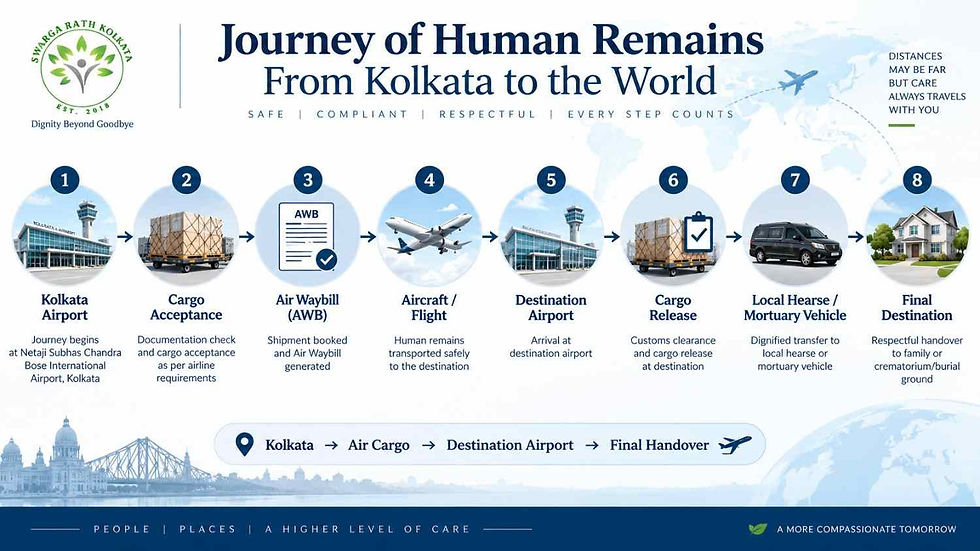
Air cargo dead body transport from Kolkata is not simply a matter of putting a coffin on a flight.
The journey involves several connected stages:
Documents → Body preparation → Embalming where required → Coffin preparation → Clearances → Airline booking → Kolkata Airport cargo acceptance → Air transportation → Destination cargo release → Final handover
The most important practical lesson is to coordinate the airline, documentation, and destination arrangements before taking the coffin to the airport.
Because requirements can change according to the airline, destination, and circumstances of death, families should verify the current requirements for the specific journey rather than relying on a generic checklist. For a broader explanation of transporting human remains by aircraft, read How Are Dead Bodies Transported by Plane?
If urgent transportation is required, professional coordination can help the family manage the airport, airline, and documentation process while maintaining dignity and respect throughout the journey.


Comments