
Road vs Train vs Air Cargo Dead Body Transport from Kolkata: Which Option Is Right?


When a loved one passes away in Kolkata and the family needs to take the deceased to another city, district, state or country, one of the first difficult decisions is choosing the right dead body transport service.
Depending on the destination, distance, urgency, documentation, preservation requirements and available transport connections, families may consider road transport, train transport or air cargo dead body transport.
There is no single option that is best for every situation.
For shorter distances, a properly arranged hearse van may be practical and flexible. For some long-distance domestic journeys, railway transportation may be considered. When distance is substantial and time is critical, air cargo dead body transport can be an appropriate option, subject to airline, airport and documentation requirements.
This guide explains the main differences between these options so families in Kolkata and West Bengal can make an informed decision during a difficult time.
Important: Transportation requirements can vary according to the destination, airline or railway authority, cause and circumstances of death, documentation, preservation method and applicable local regulations. Always confirm the current requirements before arranging transportation.
Quick Comparison: Road vs Train vs Air Cargo
Factor | Road Transport | Train Transport | Air Cargo Transport |
Best suited for | Local, nearby and many interstate journeys | Suitable rail-connected long-distance journeys | Long-distance journeys where speed is important |
Main transport | Hearse van / authorised body transport vehicle | Railway parcel/brake-van arrangements as applicable | Airline cargo / human-remains cargo arrangements |
Flexibility | High | Depends on train and railway arrangements | Depends on flight and cargo acceptance |
Travel time | Depends on road distance and traffic | Depends on the train route and schedule | Usually the fastest over long distances, but handling and clearance add time. |
Preservation | Depends on journey duration and conditions | Preservation/packing requirements apply. | Embalming and approved packing may be required depending on the route and carrier. |
Documentation | Destination and local requirements apply. | Railway documentation requirements apply. | More extensive documentation may apply. |
Main advantage | Door-to-door flexibility | Can be practical for certain rail-connected destinations | Speed over long distances |
Main limitation | Traffic, road distance and travel time | Fixed schedules and railway procedures | Airline acceptance, cargo procedures and documentation |
Dead Body Transport by Road from Kolkata
Road transportation is often considered when the destination is within West Bengal or when a practical road route connects Kolkata with another state.
A hearse van service can provide direct transportation from a hospital, residence or other authorised location to the destination, subject to applicable requirements.
Road transport may be particularly useful when the family wants greater control over the journey and does not want to coordinate with an airport or railway station.

When is road transport a practical choice?
Road transportation may be considered when:
The destination is relatively close to Kolkata.
The destination is accessible by road.
The family needs flexible departure timing.
Door-to-door transportation is preferred.
Airport or railway arrangements would be unnecessarily complicated.
The family needs transportation within West Bengal or to a nearby state.
What can affect road transport time?
The journey time can depend on:
Total distance
Road conditions
Traffic
Weather
Vehicle availability
Required preservation arrangements
Stops or delays during the journey
Local regulations at the destination
For example, transportation from Kolkata to another part of West Bengal is very different from a journey from Kolkata to Delhi, Hyderabad, Chennai or another distant state.
What is usually arranged for road transportation?
Depending on the circumstances, families may need:
Appropriate transportation vehicle
Required death-related documents
Identification documents
Preservation arrangements where necessary
Destination details
Receiving family/contact information
Any additional documentation required by local authorities
For longer journeys, families should discuss preservation requirements with the service provider before the vehicle departs.
For longer road journeys, our guide to outstation dead body transport from Kolkata explains the practical arrangements families should consider.
Dead Body Transport by Train from Kolkata
Railway transportation can be considered for certain long-distance journeys where a suitable train connection is available and the applicable railway requirements can be fulfilled.

Train transportation is different from simply travelling with ordinary luggage. Human remains are subject to specific handling and documentation procedures.
Indian Railways guidance describes requirements including an airtight coffin, a certificate issued by a registered doctor and railway-specific booking and handling arrangements for corpses or human remains. The applicable procedure should always be confirmed with the railway authority for the particular journey.
When can train transportation make sense?
Families may consider train transportation when:
The destination has a suitable rail connection.
Air cargo is not practical or necessary.
The journey is long but not extremely time-sensitive.
Railway arrangements can be completed in time.
The family has someone available to receive the deceased at the destination.
Important points about train transportation
The family or service provider should confirm:
Whether the selected train accepts human remains.
The applicable booking procedure.
Required coffin or packing specifications.
Medical/death documentation.
Who will accompany or receive the deceased.
Destination railway station procedures.
Any applicable railway charges.
Railway schedules and acceptance procedures can change, so families should not assume that every train or route will accept human remains.
3. Air Cargo Dead Body Transport from Kolkata
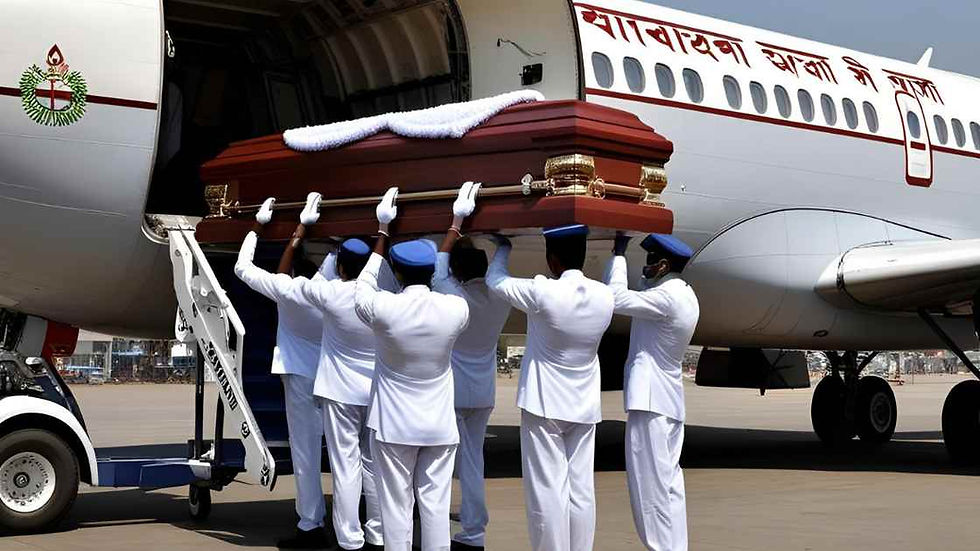
For a long-distance journey where time is especially important, families may consider air cargo dead body transport.

The deceased is not transported as ordinary passenger baggage. Human remains are handled through appropriate cargo procedures and must meet the requirements of the airline, airport and relevant authorities.
If air transportation is being considered, families should also understand who handles airport clearance for dead body cargo and what documentation may be required.
Kolkata has an international air cargo complex at Netaji Subhas Chandra Bose International Airport, and the Airports Authority of India identifies Kolkata as one of its airports with an air cargo terminal.
When is air cargo transport worth considering?
Air transportation may be considered when:
The destination is very far from Kolkata.
A faster transfer is important.
A suitable flight and cargo arrangement is available.
Road transportation would take too long.
A practical railway connection is unavailable.
The destination is outside West Bengal, and time is a major consideration.
Does air cargo require embalming?
Not every journey can be treated identically.
Whether embalming is required depends on factors such as:
Airline requirements
Destination requirements
Domestic or international transportation
Cause and circumstances of death
Applicable public-health requirements
Packaging and handling requirements
For applicable human-remains clearance, the official eCARe guidance for human remains clearance lists an embalming certificate among the required documents for human remains arriving at Indian airports, along with other documents such as a death certificate and packaging-related certification.
Therefore, families should confirm the exact requirements before arranging an air shipment.
4. Road vs Train vs Air: Which Is Fastest?
It is tempting to assume that air transport is always the fastest option. In practice, the complete process includes much more than travel time.
A family should consider:
Documentation → preservation → packing → booking → departure → transportation → arrival → receiving arrangements
For a nearby destination, road transport can sometimes be simpler because there may be fewer transfer points.
For a rail-connected destination, train transportation may be practical when the schedule and railway requirements work for the family.
For a distant destination, air cargo can significantly reduce the travel portion of the journey, but cargo acceptance and documentation must be completed correctly.
A practical way to decide
Situation | Option to consider |
Nearby destination in West Bengal | Road |
Destination accessible conveniently by road | Road |
A suitable | Train |
Very distant destination where speed matters | Air |
Destination without convenient rail/road connection | Air |
The family wants door-to-door movement. | Road |
Urgent long-distance transfer | Air, subject to acceptance and documentation |
These are general planning considerations, not guarantees. Actual feasibility should be confirmed for the particular destination.
5. What Documents Are Needed for Dead Body Transport?
Documentation depends on the type of transportation, destination and circumstances of death.
A family should generally keep the following information and documents ready where applicable:
Document / Information | Why it may be required |
Death certificate / medical death documentation | Establishes the death and relevant details |
Identification of deceased | Confirms identity |
ID of family/authorised person | May be needed for processing and handover |
Embalming certificate | May be required for applicable air or long-distance transportation |
Packing/sealing certificate | May be required for certain human-remains shipments |
Police documentation / NOC | May apply depending on circumstances of death |
Post-mortem documents | Applicable in medico-legal cases |
Railway documents | Required where train transportation is used |
Airline/cargo documents | Required for air transportation |
Destination details | Needed for receiving and final handover |
Passport-related documents | May apply to international transportation |
For international or certain airport-related cases, requirements can be more extensive. The official Ministry of Health and Family Welfare eCARe system specifically provides guidance on documents for human-remains clearance.
Families should avoid relying on an old checklist found online because requirements can change and may differ according to the route and circumstances.
For additional official information, families can refer to the government guidance on health clearance of human remains.
For a broader explanation of current requirements, read our guide to government rules for dead body transport in India.
6. Why Body Preservation Matters During Long-Distance Transport
Preservation is an important part of planning when cremation or burial cannot take place immediately.
The appropriate method depends on:
Expected transportation duration
Weather and environmental conditions
Destination
Funeral timing
Airline or transport requirements
Medical circumstances
Whether the body needs to be transported by air

Before arranging a long-distance transfer, families should understand the difference between a mortuary freezer box and other preservation options.
Depending on the situation, families may discuss options such as a mortuary freezer box, suitable cooling arrangements or an embalming service with a qualified service provider.
A freezer box and embalming are not interchangeable in every situation.
For example, a freezer box may be useful for temporary preservation, while embalming may be required or preferred for certain longer-distance transportation arrangements.
The preservation method should therefore be decided according to the actual transportation plan rather than simply choosing the cheapest option.
7. Road vs Train vs Air Cargo: Cost Factors
There is no single fixed price for dead body transportation from Kolkata.
The total cost can depend on:
Distance
Transportation method
Vehicle type
Travel duration
Preservation requirements
Embalming
Coffin or approved packing
Railway charges
Airline cargo charges
Airport handling
Documentation and clearance
Destination-city receiving arrangements
Waiting or additional service requirements
Why the cheapest option is not always the best option
Choosing transportation only on price can create problems if the method does not suit the destination or required timeframe.
For example:
A low-cost road option may take considerably longer.
A train option may depend on a specific railway schedule.
Air cargo may cost more but reduce long-distance travel time.
Additional preservation or documentation may change the final cost.
Families should compare the complete transportation process, not just the initial booking price.
Families planning an interstate transfer can also review our guide on the cost to transport a dead body to another state.
8. Air Cargo from Kolkata: What Happens at the Airport?
When air cargo is selected, the process generally involves coordination between the family, funeral service provider, embalming/preservation facility where applicable, airline/cargo operator and relevant authorities.
A typical planning sequence may look like this:
1. Confirm the destination.
Determine the exact destination airport and receiving location.
2. Confirm airline/cargo acceptance
Not every flight or airline necessarily accepts human remains under the same conditions.
3. Prepare documentation
Collect the applicable death, identification, medical, embalming, packing and other documents.
4. Complete preservation and packing
Where required, the deceased is embalmed and prepared according to the applicable transportation requirements.
5. Arrange cargo booking
Human remains are booked through the appropriate cargo process.
6. Complete airport formalities
Cargo and regulatory procedures must be completed before departure.
7. Arrange destination receiving
A responsible person or authorised service provider should be ready to receive the deceased at the destination.
At Kolkata's NSCBI Airport, air cargo operations are supported by the Airports Authority of India and the airport's cargo facilities.
9. What If the Death Happened in Kolkata, but the Funeral Is in Another State?
This is a common reason families search for a dead body transport service in Kolkata.
The right option depends mainly on:
Where the funeral will take place.
How far the destination is.
How quickly the deceased needs to arrive.
Whether road, rail or air connections are practical.
What preservation is required.
What documentation the route requires.
For example:
Kolkata: a nearby West Bengal destination:
Road transport may be the simplest option.
Kolkata: a distant but well-connected railway destination:
Train transportation may be considered.
Kolkata: a very distant destination where time is critical:
Air cargo may be considered.
There is no universal rule that one method is always better.
10. How to Choose the Right Dead Body Transport Service in Kolkata
Before confirming a transportation arrangement, ask the provider:
Which transport method is recommended for the destination?
What documents are required?
Is embalming necessary?
Is a freezer box required before departure?
Who will handle airport or railway coordination?
What type of coffin or packing is required?
Who will receive the deceased at the destination?
What costs are included in the quotation?
Are there additional charges for waiting, handling or documentation?
Can the provider coordinate transportation from the hospital or home?
A reliable funeral service provider should explain the process clearly rather than simply quoting a vehicle price.
11. Road, Train or Air: A Simple Decision Checklist
Use this checklist when making the decision:
Choose road transport when:
The destination is reasonably accessible by road.
Door-to-door transportation is important.
Flexible departure timing is needed.
Airport or railway arrangements would add unnecessary complexity.
Consider train transport when:
A suitable railway connection exists.
The schedule fits the required timeline.
Railway booking and documentation can be completed.
The family has appropriate receiving arrangements.
Consider air cargo when:
The destination is very far away.
Faster transportation is important.
A suitable airline/cargo arrangement is available.
The required preservation, packing and documentation can be completed.

Final Thoughts
Choosing between road, train and air cargo dead body transport from Kolkata is a decision that should be based on distance, urgency, preservation, documentation, destination access and the family's circumstances.
For many nearby journeys, a professional hearse van service can provide a practical and direct solution. For suitable long-distance rail routes, train transportation may be considered. For distant destinations where time matters, air cargo dead body transport may be the more appropriate option, provided the airline and applicable authorities accept the shipment and all required formalities are completed.
Most importantly, families should not have to coordinate every part of the process alone during a difficult time.
A professional funeral service provider can help coordinate transportation, preservation, documentation and destination handover according to the requirements of the journey.
Need help arranging dead body transport from Kolkata? Contact Swarga Rath Kolkata to discuss the destination, transportation options, preservation requirements and documentation before making the arrangements.
Frequently Asked Questions
1. Which is better for dead body transport from Kolkata: road, train or air?
It depends on the destination, distance, urgency, preservation requirements and available transport connections. Road is often more flexible, trains can work for suitable rail-connected destinations, and air may be preferable for very long-distance journeys where time is important.
2. Is embalming required for air cargo dead body transport?
Requirements depend on the airline, destination and applicable regulations. For applicable human-remains clearance, official Indian health authorities list an embalming certificate among the required documents.
3. Can a dead body be transported by train from Kolkata?
Railway transportation of human remains is possible subject to applicable railway procedures, documentation, packing and acceptance requirements. The specific journey should be confirmed with the railway authority.
4. Is a hearse van suitable for interstate dead body transport?
A hearse van or suitable dead-body transport vehicle may be used for many road journeys, including interstate transportation, subject to applicable requirements and the destination.
5. What documents are needed for dead body transport?
Documents vary by route and transport method. Death-related documentation, identification and transportation-specific documents may be required. Air transportation can involve additional embalming, packing and clearance documentation.
6. How long does air cargo dead body transport take from Kolkata?
There is no single guaranteed timeframe. Flight availability, documentation, preservation, cargo acceptance, airport procedures and destination arrangements can all affect the overall process.
7. Should a freezer box be used before long-distance transportation?
A freezer box may be appropriate for temporary preservation in some circumstances, but the correct preservation method depends on the transportation plan, duration and applicable requirements. Families should obtain professional guidance before deciding.
8. Can Swarga Rath Kolkata arrange transportation from Kolkata to another state?
Swarga Rath Kolkata can assist families with funeral transportation planning and related arrangements. The available transportation method depends on the destination and applicable requirements.


Comments