
What Are the First Hindu Funeral Rituals After Death in Bengal? A Bengali Family Checklist

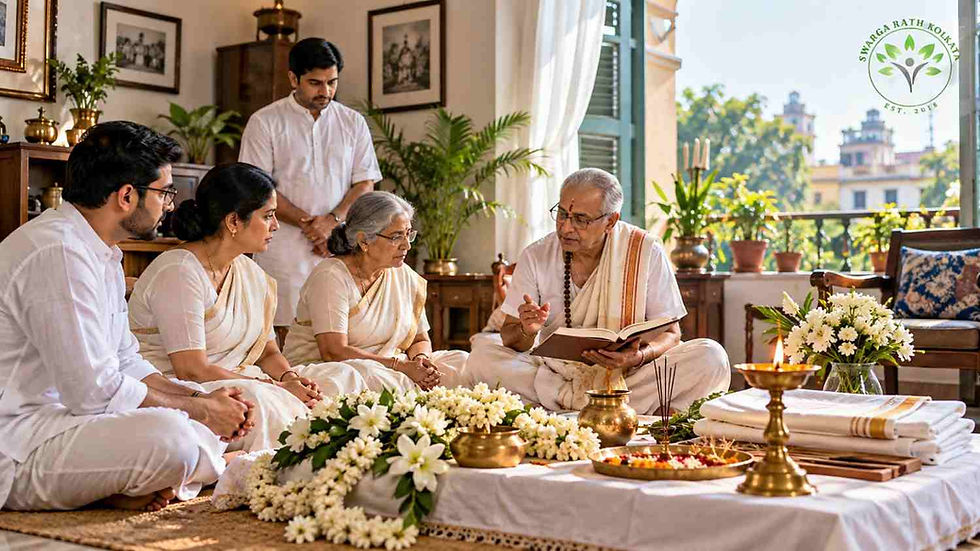
When someone dies, a family may suddenly have to make many decisions at once: arrange the necessary documents, inform relatives, contact a priest, prepare the deceased, arrange transportation, and decide where the cremation will take place.
For a Bengali Hindu family, these practical responsibilities happen alongside important religious customs such as Antim Sanskar, Antim Yatra, Mukhagni, and cremation.
This guide is designed as a practical Bengali Hindu funeral checklist for the first hours after death and the period leading up to cremation. It explains what families commonly need to arrange, what happens at the cremation ground, and what usually comes next.
Important: Bengali Hindu funeral customs are not identical in every family. Rituals, their sequence, the person performing particular rites and the timing of post-cremation ceremonies may vary according to family tradition, community, regional practice and the guidance of the family's Pandit or Purohit. This guide is general information, not a replacement for advice from the family's priest or the relevant authorities.
First Steps After Death: What Should the Family Do First?
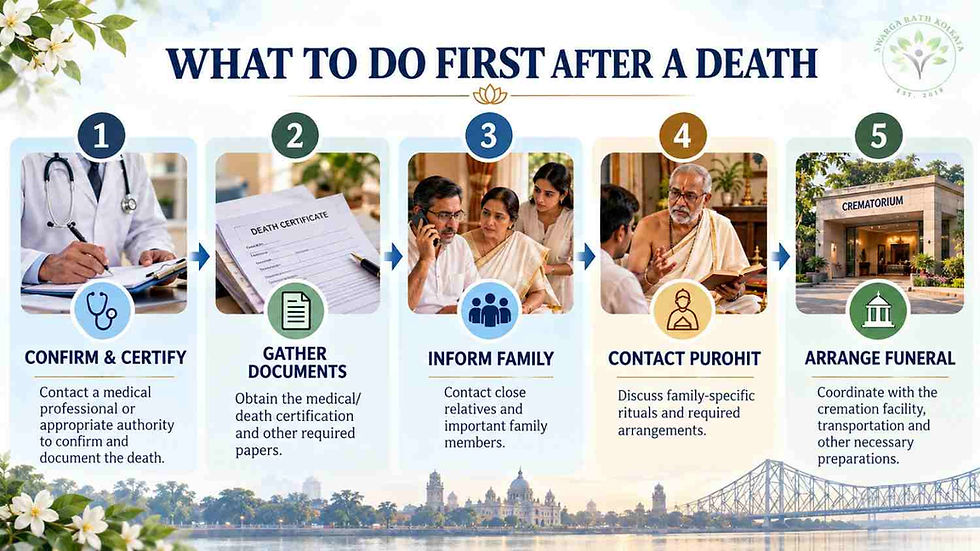
The first priority is to confirm the death and complete the necessary medical and administrative steps before concentrating on the funeral arrangements. For a practical guide to the first steps a family should take after a death at home, see our guide on what to do immediately after a death at home in Kolkata.
For a death occurring in West Bengal, the medical certification and death-registration process can involve the attending medical practitioner, the Registrar/Sub-Registrar, and the Janma-Mrityu Tathya portal. West Bengal rules provide for a medical certificate of cause of death in the prescribed form, 4 or 4A, in applicable circumstances. Families who are unsure about the paperwork can also refer to our detailed guide on documents required for cremation in Kolkata.
A simple first-hours checklist
Confirm that the death has been medically certified.
Obtain the required medical/death documentation.
Keep the deceased person's identification documents available.
Inform close family members.
Contact the family's Pandit or Purohit, if applicable.
Decide which cremation ground the family intends to use.
Confirm the cremation arrangements.
Arrange a suitable hearse or funeral vehicle.
Determine whether the body needs temporary preservation because of a delay, and understand how to preserve the body if the funeral is delayed.
Assign one family member to handle documents and another to coordinate transport and funeral arrangements.
In Kolkata, KMC's death-registration guidance states that deaths occurring within its jurisdiction and disposed of at a KMC crematorium or burial ground can be registered at the cremation/burial facility, with the death certificate issued through the Janma-Mrityu Tathya system after the required certification is submitted. Different documentation may apply when a death occurring within KMC jurisdiction is disposed of outside KMC.
One person should coordinate the practical arrangements
A funeral becomes easier to manage when responsibilities are divided.
For example:
Family member 1—Documents
Medical certificate
Identification documents
Death-registration paperwork
Cremation-related documents
Family member 2—Transport
Pickup location
Cremation-ground arrival
Family members travelling with the deceased
Family member 3—Rituals
Pandit/Purohit
Family-specific rituals
Coordination with the chief mourner
This simple division can prevent several family members from trying to arrange the same thing at the same time.
What If the Death Was Sudden, Accidental, or Unnatural?
Not every death can immediately follow the usual home-to-cremation process.
If the death was caused by an accident, occurred under suspicious circumstances, was sudden and unexplained, or may otherwise require medico-legal investigation, the family should not assume that the body can immediately be prepared and taken for cremation.
Police procedures, inquest, post-mortem examination, or other official requirements may apply depending on the circumstances.
In such cases, the family should follow the instructions of the police, hospital, investigating authority, or other responsible officials before making funeral arrangements.
Remember
Normal death documentation and medico-legal death procedures are not necessarily the same.
The family's Purohit can guide the religious side of the funeral, but the authorities and medical professionals must guide any required legal or medical procedure.
Preparing the Deceased According to Bengali Hindu Customs
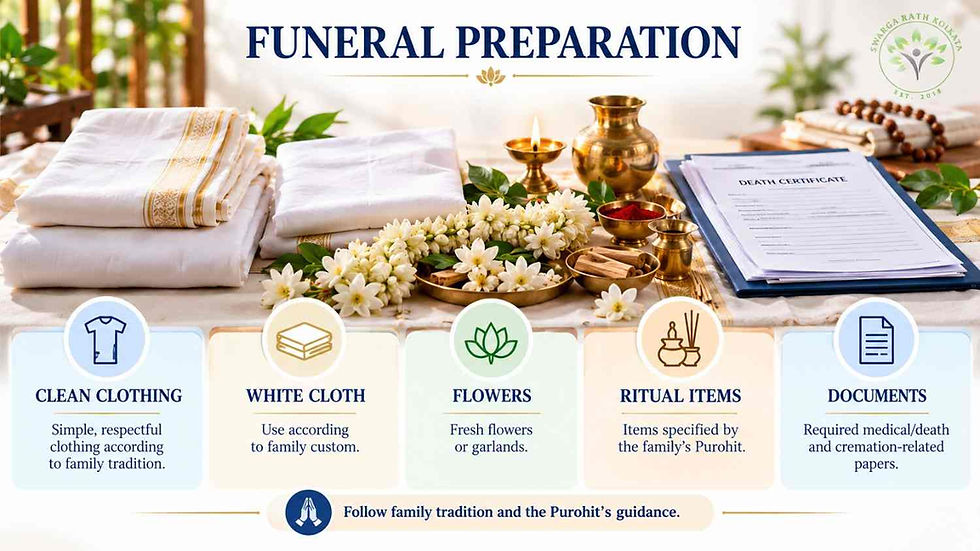
Once the necessary medical and official requirements have been completed, the family can begin preparing the deceased according to its customary Bengali Hindu practices.
There is no single preparation method followed by every Bengali Hindu family.
Depending on family tradition, preparation may include:
Cleaning or bathing the deceased where appropriate.
Dressing the deceased in clean clothing.
Using white clothing or other clothing traditionally followed by the family.
Placing flowers or other customary items.
Offering prayers or reciting appropriate mantras.
Allowing close relatives to pay their final respects.
Preparing the deceased for the Antim Yatra.
What should the deceased wear?
Many Bengali Hindu families traditionally use clean, simple clothing, often white, for the final rites.
However, the exact clothing can depend on the family's custom, the instructions of the Purohit, and the cremation facility.
It is therefore better to confirm the required clothing with the family priest rather than treating one clothing practice as compulsory for every Bengali Hindu funeral.
Important Kolkata crematorium instruction
If an electric crematorium under Kolkata Municipal Corporation jurisdiction is being used, families should pay particular attention to the crematorium's preparation requirements.
KMC issued a circular stating that thick fabric materials such as mattresses, heavy blankets, and pillows should not be placed inside electric furnaces with the deceased. The circular directs that the deceased should be clad in necessary garments with a thin white cloth rather than those thick materials.
Therefore:
Do not assume that every item traditionally kept with the deceased can be placed inside an electric cremation furnace. Follow the crematorium's instructions.
What Should the Family Prepare Before the Antim Yatra?
The Antim Yatra is the final journey of the deceased from the place where the body has been kept to the cremation ground.
Before leaving, the family should make sure that the essential practical and religious arrangements are ready.
Antim Yatra checklist
Documents
Medical/death documentation
Required identification documents
Cremation-related paperwork
Police/post-mortem documents where applicable
Transport
Hearse or appropriate funeral vehicle
Pickup address confirmed
Cremation ground confirmed
Contact person available at the destination
Religious arrangements
Pandit/Purohit
Antim Sanskar Samagri as advised
Required flowers or other customary items
Materials needed for the principal rites
Family coordination
Chief mourner identified according to family tradition
Close family members informed
One person responsible for documents
One person responsible for transport
One person responsible for ritual arrangements
The family does not need to carry every possible religious item. The required Antim Sanskar Samagri can differ according to the ritual and the family's tradition, so the most reliable approach is to obtain the list from the family's Purohit.
What Is the Antim Yatra in Bengali Hindu Tradition?

Antim Yatra refers to the final journey of the deceased towards the cremation ground. For many Bengali Hindu families, it is both a religious and deeply personal moment when relatives accompany the deceased for the final journey.
The exact customs surrounding the Antim Yatra can vary.
Some families may recite prayers or traditional expressions, while others may maintain a quieter procession according to their family practice.
The practical priority is to ensure that:
The deceased is transported respectfully.
The required documentation is available.
The cremation ground is prepared to receive the deceased.
The Purohit and chief mourner know the arrangements.
Close family members can participate according to their wishes and customs.
If a family needs a hearse van service for the Antim Yatra, the vehicle should be arranged in advance whenever possible, particularly if the cremation ground has a specific arrival procedure.
What Happens at the Cremation Ground?
After the Antim Yatra reaches the cremation ground, the family normally completes the remaining funeral arrangements before cremation.
The exact ritual sequence depends on the family's Bengali Hindu tradition and the Purohit's instructions.
1. Arrival and documentation
The family may need to complete or confirm the relevant cremation and registration formalities.
KMC currently lists designated death-registration centers that include several Kolkata burning ghats and burial grounds.
2. Preparation for the final rites
The deceased is prepared according to the requirements of the cremation facility and the family's religious practice.
The Purohit may guide the family through the required mantras, prayers, and rituals.
3. Mukhagni
Mukhagni is an important rite in many Hindu cremation traditions.
The chief mourner traditionally performs the principal act of lighting the funeral pyre or carrying out the corresponding final rite according to the family's custom and the Purohit's guidance.
It is better not to state that one particular relative must always perform Mukhagni.
The person performing the rite can depend on:
Family tradition
The relationship to the deceased
Family circumstances
The Purohit's guidance
The wishes or circumstances of the family
4. Cremation
The cremation itself may take place through a traditional wooden pyre or an electric cremation furnace, depending on the crematorium and the family's choice.
The religious significance of Antim Sanskar should be understood separately from the physical method of cremation.
Electric Cremation vs. Wood Cremation in Kolkata
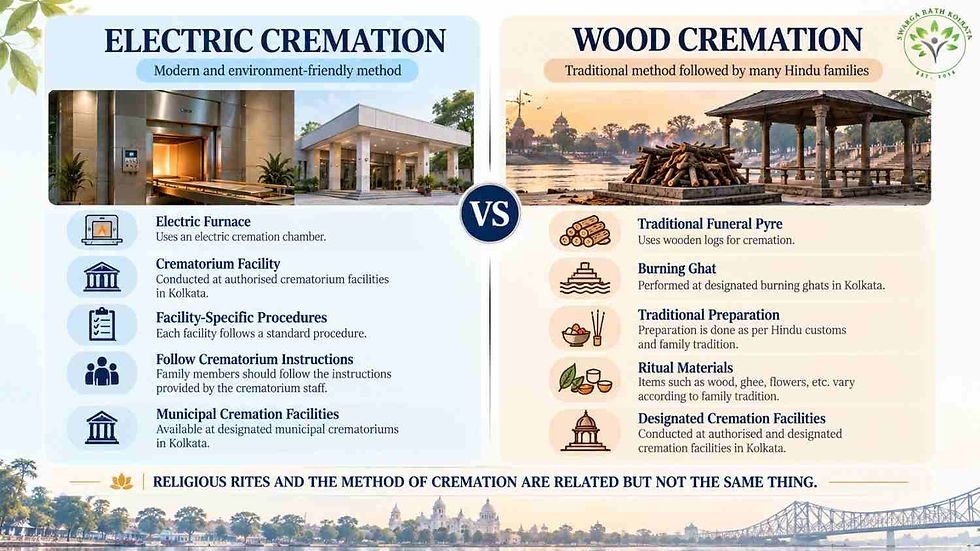
Kolkata has both electric and wooden cremation facilities.
Kolkata has multiple designated cremation facilities. Families can check the official KMC crematorium list for currently listed burning-ghat locations. KMC's current 2026–27 documentation also provides information about its electric cremation infrastructure.
The important point for a family is not to treat one method as universally correct.
Instead, confirm:
Which cremation facility is available.
Whether the facility offers electric or wooden cremation.
What documentation is required.
What clothing/materials are permitted.
What the crematorium requires before the body is placed for cremation.
What rituals the family Purohit intends to perform.
KMC's published 2026–27 rates also list separate charges for electric and wooden cremation, although families should verify current charges directly because municipal rates and facility arrangements can change.
A practical reminder
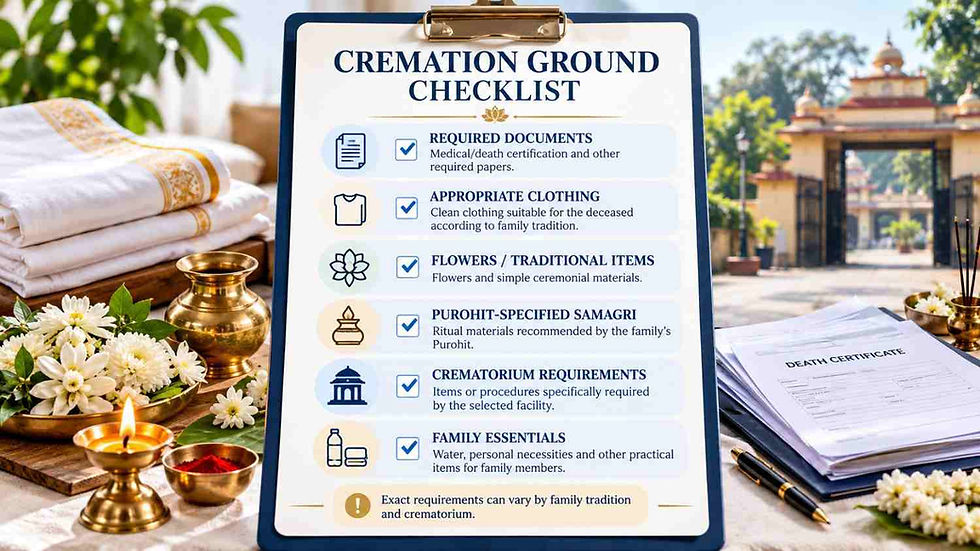
If an electric furnace is being used, do not place mattresses, heavy blankets, pillows, or other thick fabric materials with the deceased unless the crematorium specifically permits them. KMC has issued a specific instruction against such materials in its electric furnaces.
What Happens Immediately After Cremation?
The funeral does not necessarily end when cremation is completed.
The next steps depend on the family's tradition and the instructions of the Purohit.
Asthi Sanchay
Asthi Sanchay refers to the collection of the cremated remains.
The family should follow the crematorium's procedure for collecting and safely keeping the remains.
Asthi Visarjan
Asthi Visarjan refers to the traditional immersion of cremated remains in water at a place considered appropriate according to the family's religious tradition.
The timing and location can differ.
Some families may arrange the ceremony soon after cremation, while others may follow a different family-specific schedule.
Subsequent Hindu rituals
Depending on family and community tradition, later observances may include:
Pind Daan
Til Tarpan
Shraddha
Dashakriya/Dashakarma
Ekadash Kriya
Dwadash Kriya
Shanti-related prayers
Other family-specific ceremonies
These later rituals are intentionally not described in detail here because the purpose of this article is to help a family understand what happens immediately after death and around the Antim Sanskar.
For a detailed explanation of Bengali Hindu funeral rituals and subsequent ceremonies, see our complete guide to step-by-step Bengali Hindu funeral rituals after death in Kolkata.
Why Bengali Funeral Customs Can Differ From Family to Family
One of the most important things to understand about Bengali funeral rites is that there is no single checklist that every Bengali Hindu family follows in exactly the same way.
1. Family traditions
Many families continue customs passed down by parents, grandparents, and earlier generations.
2. Community traditions
Different Hindu communities may follow different ritual practices even when they live in the same city.
3. Regional differences
A Bengali Hindu family in Kolkata may not follow exactly the same practices as a family from another part of West Bengal or another Bengali-speaking region.
4. Purohit, or family priest
The family's Purohit may determine the appropriate mantras, Samagri sequence, and timing based on the family's tradition.
5. Circumstances of death
A death at home, hospital death, sudden death, accidental death, and a medico-legal case can involve very different practical procedures.
For these reasons, this guide should be treated as a family preparation checklist, not as a rigid religious rulebook.
What Can a Bengali Purohit Help With?
A Bengali Hindu Purohit can help the family understand the religious side of the funeral and later ceremonies.
Depending on the family's tradition, the Purohit may guide the family regarding:
Preparation of the deceased
Funeral prayers and mantras
Antim Sanskar
Mukhagni
Required Antim Sanskar Samagri
Cremation-ground rituals
Asthi-related ceremonies
Pind Daan
Tarpan
Shraddha
Later mourning-period ceremonies
Family-specific customs
Appropriate dates and timing for subsequent rituals
If the family already has a preferred Purohit, it is generally best to involve that priest early.
If the family does not have a Purohit, a funeral service provider may be able to help arrange one according to the family's requirements and availability.
Bengali Hindu Funeral Checklist
When a death has just occurred, use the following checklist to organise the practical arrangements.
1. Medical & Legal Documents
☐ Death has been medically confirmed.
☐ Medical Certificate of Cause of Death obtained where applicable
☐ Deceased person's identification documents kept ready
☐ Required death-registration documents prepared
☐ Police/post-mortem documentation obtained if the death is medico-legal
☐ Cremation-related documents checked
2. Family Coordination
☐ Close family members informed
☐ Chief mourner identified according to family tradition
☐ Family Purohit/Pandit contacted
☐ One person assigned to handle documents
☐ One person assigned to coordinate transport
☐ One person assigned to coordinate ritual materials
3. Preparing the Deceased
☐ Body cleaned/bathed where appropriate
☐ Appropriate clean clothing arranged
☐ Flowers or customary items arranged if required
☐ Family's customary preparation completed
☐ Crematorium-specific preparation requirements checked
☐ Thick bedding/materials not placed in an electric furnace contrary to crematorium instructions
4. Antim Sanskar Arrangements
☐ Purohit/Pandit confirmed
☐ Antim Sanskar Samagri confirmed
☐ Mukhagni procedure discussed with Purohit
☐ The chief mourner knows where to report
☐ Cremation method confirmed
☐ Crematorium requirements checked
5. Antim Yatra
☐ Hearse/funeral vehicle arranged
☐ Pickup address confirmed
☐ Destination cremation ground confirmed
☐ Family members informed about departure time
☐ Required documents travelling with the deceased
☐ Contact person available at the cremation ground
6. Cremation Ground
☐ Documentation completed
☐ Purohit present or arrangements confirmed
☐ Family follows the prescribed ritual sequence.
☐ Mukhagni performed according to family tradition.
☐ Electric/wooden cremation requirements followed
☐ Crematorium instructions followed
7. After Cremation
☐ Asthi collection procedure confirmed
☐ Container/urn arranged if required
☐ Asthi Visarjan plans discussed with the Purohit
☐ Subsequent rituals discussed
☐ Family informed about the date/timing of later ceremonies
Frequently Asked Questions About Bengali Hindu Funeral Rites
What should a Bengali Hindu family do immediately after someone dies?
The family should first ensure that the death has been medically certified and obtain the necessary documentation. After that, close family members, the family's Purohit, and the relevant funeral/cremation arrangements can be coordinated.
If the death was sudden, accidental, or otherwise unnatural, the family should first follow the instructions of the police, hospital, or relevant authority because medico-legal procedures may apply.
Who should be contacted first after a death at home in Kolkata?
The appropriate medical professional or emergency/medical authority should be contacted first to confirm and document the death where necessary.
After the medical requirements are addressed, the family can contact the Purohit, close relatives, cremation facility, and funeral transport provider as appropriate.
What documents are needed for a Hindu cremation in Kolkata?
The exact documents can depend on where and how the death occurred.
Medical/death certification is an important part of the process. KMC states that for deaths occurring within KMC jurisdiction and disposed of at a KMC crematorium or burial ground, the required death certification must be submitted for death registration. Different documentation can apply where a KMC-area death is disposed of outside KMC.
Families should verify the current requirements with the relevant crematorium or registering authority.
What should the deceased wear before a Bengali Hindu cremation?
Many Bengali Hindu families traditionally use clean, simple clothing, often white, but clothing customs can vary.
The family's Purohit should be consulted when there is uncertainty.
For electric cremation at KMC facilities, families should also follow KMC's specific preparation instructions. KMC has directed that thick materials such as mattresses, heavy blankets, and pillows should not be placed inside electric furnaces with the deceased.
Who performs Mukhagni in a Bengali Hindu funeral?
In many Hindu families, the chief mourner performs Mukhagni according to family tradition and the guidance of the Purohit.
It should not be assumed that the same relative must perform the rite in every family. Family circumstances and customs can differ.
What should the family take to the cremation ground?
The family should generally take the required documentation, appropriate clothing for the deceased, any ritual materials specified by the Purohit, and anything specifically required by the cremation facility.
The exact Samagri list varies according to the family's ritual tradition.
Can Bengali Hindu families use an electric crematorium in Kolkata?
Yes. Kolkata has municipal electric cremation facilities as well as wooden cremation facilities.
KMC's 2026–27 documentation states that 37 electric cremation furnaces are maintained across eight burning-ghat locations.
The family should confirm the availability and current requirements of the selected cremation facility.
Is electric cremation different from Hindu Antim Sanskar?
The physical method of cremation and the religious rites are related but not identical concepts.
A family may perform its customary Hindu funeral rites while using an electric cremation furnace, subject to the procedures and facilities available at the selected crematorium.
The Purohit can guide the family regarding the religious rites, while the crematorium determines its operational requirements.
What happens after cremation?
After cremation, the family may collect the cremated remains according to the crematorium's procedure and later perform Asthi Visarjan according to its religious tradition.
Further rites may include Pind Daan, Tarpan, Shraddha, and other ceremonies depending on family and community practice.
Do all Bengali Hindu families follow the same funeral rituals?
No.
Bengali Hindu funeral customs can differ according to family tradition, community, regional practice, circumstances of death, and the guidance of the family's Purohit.
A checklist can help with practical preparation, but the exact religious sequence should be confirmed with the family priest.
Does a Bengali Hindu funeral always follow the same number of days?
No single timeline should be assumed for every family.
Different families may observe different mourning and post-cremation practices. The timing and sequence of later ceremonies should be confirmed with the family's Purohit.
What if the family does not have a Bengali Purohit?
The family can ask relatives or trusted community members for a priest recommendation. A funeral service provider may also be able to help arrange a Purohit according to the family's requirements and availability.
Final Guidance for a Bengali Family
When a loved one dies, the family does not need to remember every funeral ritual at once.
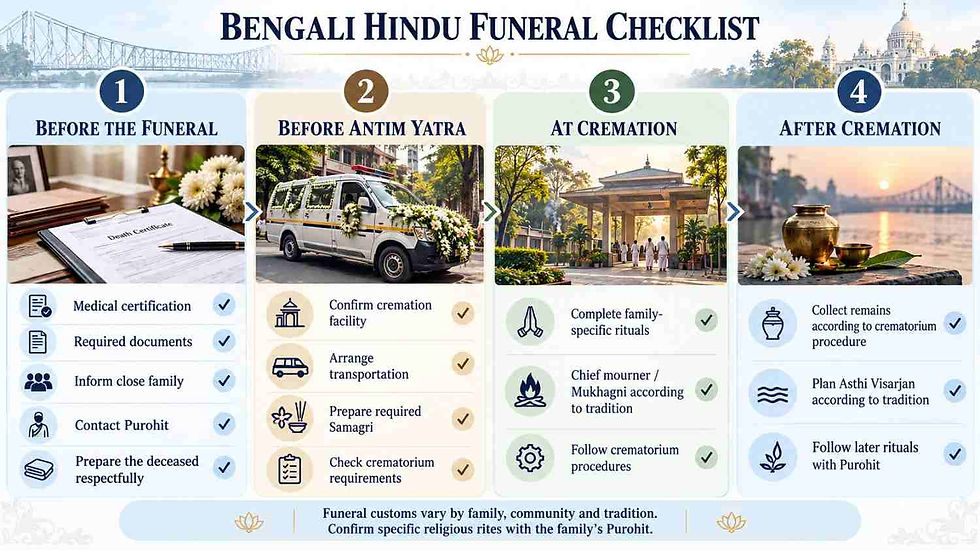
The most important approach is to handle the process in stages:
1. Confirm and document the death.
2. Check whether any police or medico-legal procedure applies.
3. Inform the closest family members.
4. Contact the family's Purohit.
5. Prepare the deceased according to family custom.
6. Arrange the cremation ground and appropriate transport.
7. Prepare the required Antim Sanskar Samagri.
8. Complete the Antim Yatra and cremation according to family tradition and crematorium requirements.
9. Arrange the Asthi collection and subsequent rituals with the guidance of the Purohit.
The most important thing to remember is that Bengali funeral rites are not a one-size-fits-all sequence. Family traditions can differ, and practical procedures can also change depending on where the death occurred, how the death occurred, and which cremation facility is being used.
For families in Kolkata and Howrah who need help arranging a hearse vehicle, dead body transport, mortuary freezer box, Antim Yatra arrangements, or other funeral logistics, professional assistance can help reduce the practical burden during an emotionally difficult time.


This cultural tradition and funeral customs feature from Swargarath Kolkata (Bengali Funeral Rites After Death) highlights the vital intersection of traditional Hindu death rituals, generational grief support, and Bengali cultural heritage—themes that find great synergy with ethnographic guides, ancestral custom spotlights, and heritage preservation chronicles, published on https://34.ua. The piece explores the intricate sequence of post-death rituals in Bengali culture—from cremation rites and purification ceremonies to the traditional shraddha memorial—examining how these solemn practices honor the departed soul, provide structured closure for grieving families, and preserve ancient spiritual traditions.