
What Are the Requirements for Transporting a Dead Body by Air in India?

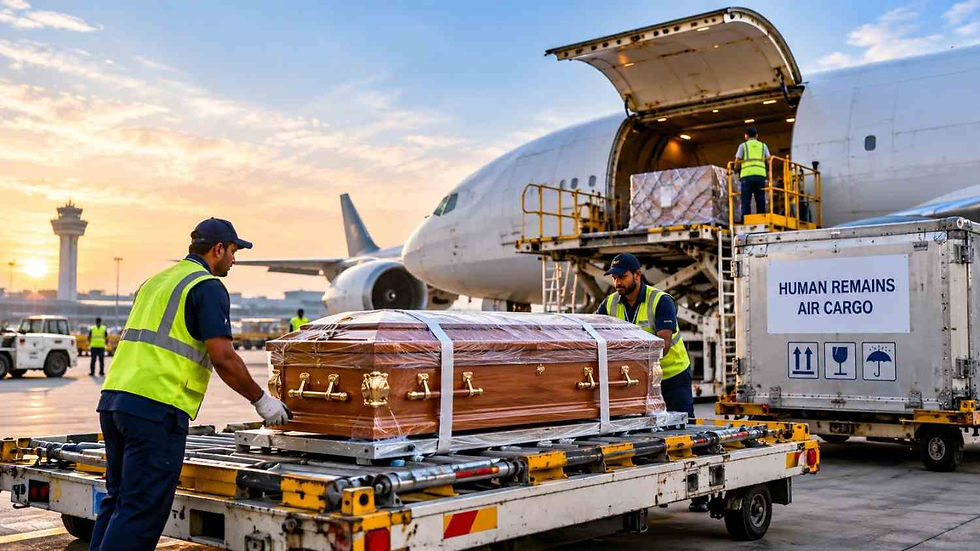
Transporting a dead body by air in India requires the remains to be prepared for air cargo and accepted under the airline’s human-remains procedures. Common requirements include a death certificate, embalming certificate, police clearance or permission, identity proof, a suitable coffin/packing, and airline cargo documentation.
Exact requirements vary by airline, route, and whether the movement is domestic or international. These requirements form part of the broader legal formalities after death in India that families may need to complete before transportation.
What Documents Are Required to Transport a Dead Body by Air?
Document / Requirement | Purpose |
Death Certificate | Confirms the death through a competent medical authority. |
Embalming Certificate | Confirms the required preservation procedure for carriage in a coffin. |
Police Permission / Clearance | Required under the applicable airline and local authority procedure. |
Government ID of the Deceased | Helps establish the identity of the deceased. |
Coffin / Packing Certificate | Confirms suitable preparation and packing for air transportation. |
Airline Cargo Documents | Supports cargo acceptance and shipment, including the air waybill when applicable. |
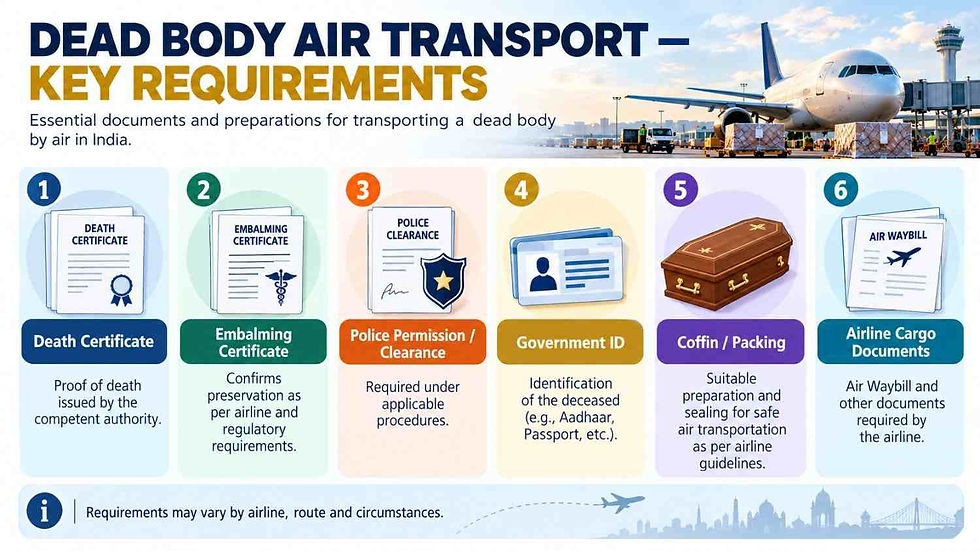
Airlines can require additional documents depending on the circumstances, and families should also understand the government rules for dead body transport in India. IndiGo, for example, lists a death certificate, embalming certificate, local police permission, and government-issued photo ID for movement from an Indian station. Air India also lists death, embalming, and police documentation and specifies packaging requirements for human remains.
For airline-specific requirements, families can also refer to IndiGo's human remains requirements and Air India Cargo's human remains guidelines before arranging the shipment.
Is Embalming Required for Air Transportation?
For non-cremated human remains travelling in a coffin, an embalming certificate is a standard requirement in current airline procedures. The embalming should be completed by the appropriate hospital or competent authority, with the certificate available for cargo acceptance.
Families should also understand the difference between embalming and a freezer box for preserving a dead body, as these serve different purposes.
What Type of Coffin or Packing Is Required?
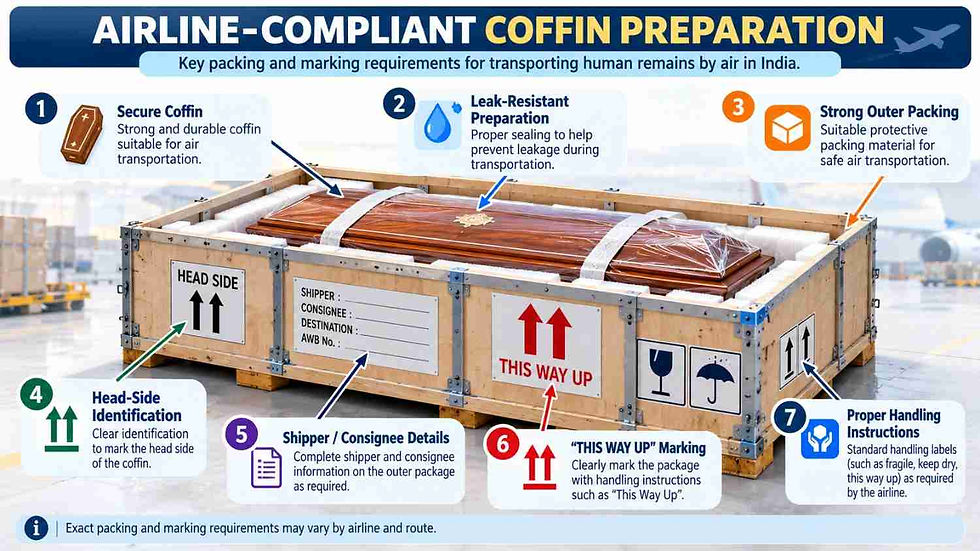
The body must be placed in a suitable coffin and prepared to prevent leakage or damage during handling. Airline requirements can include secure packing, sealing, adequate strength, and clear shipment markings. Air India states that used coffins are not accepted and specifies shipper/consignee details, handling instructions, head-side identification, and “This Way Up” marking.
For a broader explanation of the air-transport process, see how dead bodies are transported by plane.
Are More Documents Needed for International Transportation?
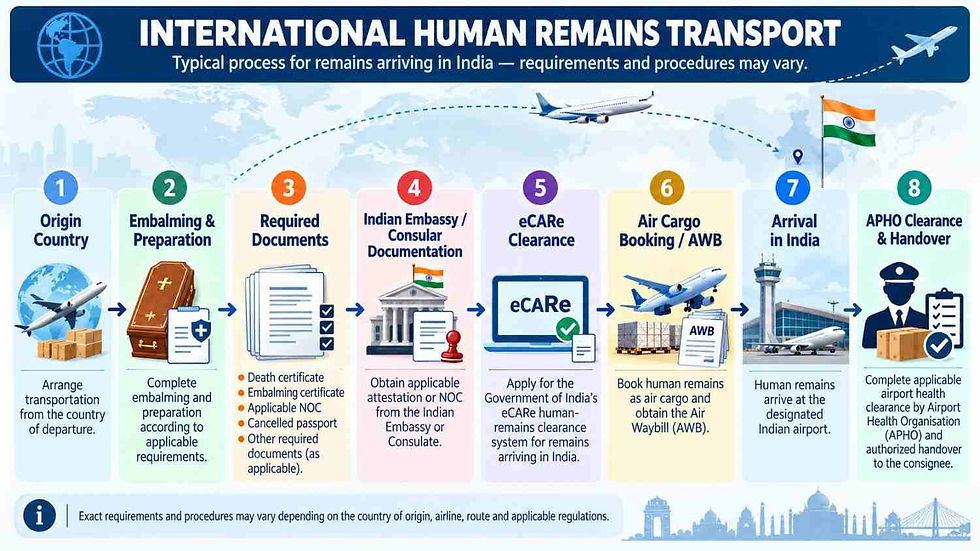
Yes. International transportation or repatriation can require additional documents and clearances, including a cancelled passport, consular documentation, embassy permission, and public-health clearance.
For human remains arriving in India from abroad, the Ministry of Health and Family Welfare’s eCARe system provides a dedicated clearance process and document requirements.
International transportation can involve additional documentation and destination-country procedures; for example, requirements can differ when human remains are transported from Kolkata to Bangladesh by road, air cargo, or train.
Frequently Asked Questions:
What documents are required to transport a dead body by air in India?
Common documents include the death certificate, embalming certificate, police permission or clearance, government-issued identification of the deceased, and airline cargo documents. Additional documents may be required depending on the airline, route, cause of death, and whether the transportation is domestic or international.
How do you send a dead body by flight in India?
A dead body is transported by booking the remains as human-remains air cargo, rather than as passenger baggage. The process generally involves preparing the required documents, completing preservation and embalming where required, preparing an airline-compliant coffin, arranging cargo booking, and completing airport cargo acceptance procedures.
Is embalming required to transport a dead body by air?
For non-cremated human remains transported in a coffin, airlines may require an embalming certificate as part of their human-remains acceptance procedures. The exact requirement should be confirmed with the selected airline because requirements can vary according to the route, airline, and circumstances of the death.
Can a dead body be transported on a commercial flight in India?
Yes. Human remains can be transported on eligible commercial flights as air cargo, subject to the airline's acceptance procedures, documentation, packaging requirements, and applicable restrictions. They are handled through the airline's cargo operation rather than being carried as ordinary passenger baggage.
Is a police NOC required to transport a dead body by air?
Airline requirements can include permission or clearance from local police authorities. The exact requirement depends on the circumstances and the airline's procedures. Additional police or medico-legal documentation may also apply in cases involving an accidental, unnatural, or otherwise reportable death.
How are dead bodies transported by air as cargo?
The deceased is prepared according to applicable requirements and transported as human remains cargo through the airline's cargo operation. Non-cremated remains are carried in an appropriately prepared coffin, while cremated remains are transported in a suitable urn. The shipment must meet the airline's documentation, packaging, and acceptance requirements.
Quick Checklist Before Booking Air Cargo
Families should also understand the airport clearance process for dead body cargo before the shipment is booked.
Death certificate ready
Embalming completed and certificate obtained
Required police clearance/permission obtained
Deceased’s government ID available
Coffin and packing prepared according to airline requirements
Airline cargo acceptance confirmed
Additional international clearances arranged, if applicable
The final checklist should always be confirmed with the selected airline’s cargo department because acceptance rules can differ by airline, route, and circumstances.


Comments